The Quiet Revolution Happening in the Software Industry (And Why Smart Founders Are Paying Attention)

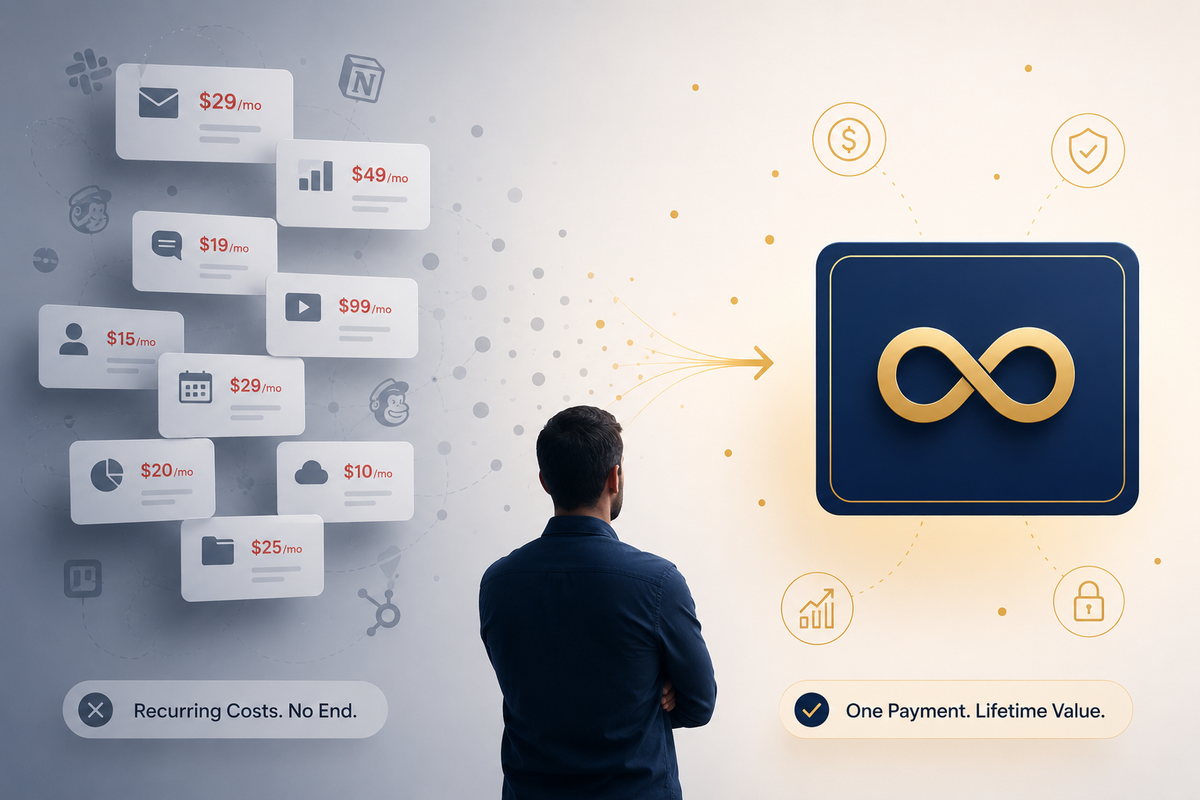
Subscription fatigue is real. Here's the under-the-radar movement that's changing how online businesses buy software, and why traditional SaaS is starting to sweat.
Something interesting has been happening in the software world over the last few years.
It hasn't made the front page of TechCrunch. It hasn't been talked about at the big SaaS conferences. And most VCs would tell you it doesn't exist or that it doesn't matter.
But quietly, in the background, an entire economy has been built around a single idea:
What if you could own your software instead of renting it?
Welcome to the world of Lifetime Deals (LTDs). And if you're running an online business, this might be the most important shift you haven't been paying attention to.
The Subscription Trap Nobody Talks About
Let me paint you a picture.
The average online entrepreneur uses somewhere between eight and fifteen software tools every single day. Email marketing. Design. SEO. Project management. Analytics. Social media scheduling. AI writing assistants. CRM. The list goes on.
Each of those tools, individually, feels like a reasonable expense. Twenty-nine dollars a month here. Forty-nine dollars there. Nineteen dollars somewhere else.
But here's where it gets interesting. When you add it all up, the average solopreneur or small business is spending between two thousand and six thousand dollars per year on software subscriptions. Some are spending well over ten thousand.
And that's just to operate. Not to grow. Not to scale. Just to keep the lights on.
This is what the SaaS industry calls "the subscription economy." What it really is, though, is a quiet recurring tax on doing business online.
For most of the last decade, this was just the way things were. You wanted to use software, you paid every month, forever. End of story.
Until a quiet movement started to push back.
The Birth of the Lifetime Deal Economy
Around 2014, a company called AppSumo started doing something unusual. Instead of charging customers monthly for software, they began negotiating with software vendors to offer one-time lifetime licenses.
The deal was simple. The customer pays once. They own the tool. Forever. No renewals, no monthly fees, no surprise price increases.
For software companies, it was a fast way to get cash upfront, build a user base, and bypass the slow grind of monthly subscription growth.
For customers, it was a chance to break free from subscription fatigue.
What started as a niche concept has now grown into a full ecosystem. Today, you can find lifetime deals on platforms like PitchGround, DealFuel, SaaSMantra, RocketHub, StackSocial, and many more. Some software companies even run their own direct lifetime deals to attract loyal early users.
And the deals are getting better.
Email marketing platforms that normally cost three hundred dollars a year? You can find lifetime deals for under fifty dollars.
AI writing tools that compete with Jasper or Copy.ai? Lifetime access for under one hundred dollars.
Video and design platforms that would cost you over a thousand dollars annually? One-time lifetime deals for under one hundred and fifty.
The savings, when you do the math over five or ten years, are absurd.
Why This Matters More Than People Think
Here's something most people miss.
When you stack monthly subscriptions, you're not just losing money. You're losing flexibility. You're losing leverage. You're locked into a cycle where every slow month means deciding which tools to cut, which features to lose, which workflows to break.
Lifetime deals flip that completely.
When you own your tools, you operate from a position of strength. Your costs are predictable. Your tools can't disappear if you skip a payment. You're not held hostage by surprise price hikes (and they do happen — just ask anyone who used Notion, Slack, or Adobe in the last few years).
For bootstrapped founders, freelancers, agencies, and content creators, this is genuinely transformative. The five thousand dollars you would have spent on subscriptions this year? That can go into ads, into hiring, into actually growing your business.
And the funny thing is, in most cases, the lifetime deal tools are just as good as the subscription ones. Sometimes better. Many of them are built by smaller, hungrier teams who actually listen to their users.
But Are Lifetime Deals Risky?
This is the question everyone asks, and it's a fair one.
The honest answer is yes, some of them are. Like any market, the lifetime deal world has its share of products that overpromise and underdeliver. There are companies that disappear within a year. There are tools that get acquired and shut down. There are deals that look amazing on paper but turn out to be half-finished software.
But here's the thing. The same is true of monthly subscriptions. The graveyard of dead SaaS startups is enormous. The difference is, when a monthly tool dies, you've already paid for service you never received. When a lifetime deal product dies, you've usually paid less in total than you would have paid in three months of subscriptions.
The real skill in this space isn't avoiding lifetime deals. It's knowing how to evaluate them. Looking at the company behind the product. Checking for an active development roadmap. Reading recent reviews. Making sure there's a real refund policy. Understanding what you actually need versus what just looks shiny.
Once you learn how to spot the good ones, the upside is enormous and the downside is small.
What's Coming Next
The lifetime deal industry is growing fast. New platforms are launching every year. Software companies that used to scoff at the concept are now actively offering lifetime deals to break into competitive markets. AI has accelerated this even more, with white-label AI platforms being sold for one-time payments that would have cost five hundred dollars per month a few years ago.
If the last decade of online business was defined by the subscription economy, the next decade might be defined by something different. Something more sustainable. Something that puts ownership back in the hands of the people actually building businesses.
And the people who figure this out early are going to have an enormous advantage over those who don't.
Where to Start
If you're new to all of this, the best first step is simple. Sit down and audit every software subscription you currently pay for. Add them up. Look at the annual number.
Then, for each one, ask the question: Is there a lifetime deal for this? Or for something just as good?
Nine times out of ten, the answer is yes.
That's exactly why I started LTD Marketplace. To make it easier for entrepreneurs and online business owners to find the lifetime deals worth buying, without wading through hundreds of shady offers and forgotten platforms.
If you want to see what's currently available, head over to LTDmarketplace.com and take a look. We curate deals weekly, write honest reviews, and only feature tools we'd genuinely use ourselves.
The subscription economy isn't going anywhere overnight. But the people who are quietly opting out of it? They're building leaner, more profitable, more flexible businesses.
And the gap between them and everyone else is only going to grow.